
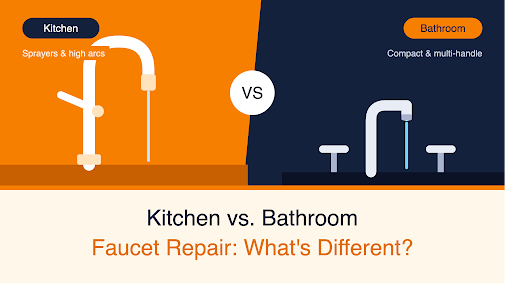
At first glance, a faucet is a faucet. Water goes in, water comes out, and when something goes wrong, you fix it. But anyone who has actually worked on both a kitchen faucet and a bathroom faucet knows the truth: they are built differently, they fail differently, and they demand different repair approaches.
Understanding those differences saves time, money, and a lot of frustration. Whether you’re a homeowner tackling a DIY repair or a business owner trying to figure out why your commercial restroom sink is acting up, here’s what sets kitchen and bathroom faucet repair apart.
The Fundamental Design Difference
Kitchen faucets are the workhorses of the plumbing world. They are designed to handle high-volume use, frequent on-off cycles, and the demands of cooking, cleaning, and food preparation. Bathroom faucets, by contrast, are built for lighter, more intermittent use.
That core difference in purpose shapes everything else.
Kitchen Faucets: Complex by Necessity
Modern kitchen faucets have evolved into sophisticated pieces of equipment. Many now feature:
- Pull-down or pull-out spray heads with multiple spray modes
- Soap dispensers integrated into the faucet body
- Touchless or motion-sensor activation on higher-end models
- High-arc spouts to accommodate large pots and pans
- Swivel bases for flexibility over double sinks
Each of these features adds moving parts, seals, and potential failure points. A pull-down spray head, for example, relies on a hose that retracts inside the spout, a weighted counterbalance, and a diverter mechanism. When any of those components fail, the repair is more involved than simply replacing a washer.
Bathroom Faucets: Simpler in Function, Varied in Form
Bathroom faucets are generally less mechanically complex. They don’t typically have pull-down sprayers or multiple spray modes. But they make up for that simplicity with a wider variety of configurations:
- Single-handle faucets with one cartridge controlling both temperature and flow
- Two-handle faucets with separate stems or cartridges for hot and cold
- Centerset faucets with all components on a single base
- Widespread faucets with separate hot, cold, and spout components
- Wall-mount faucets that are built into the wall rather than the sink deck
That variety means a bathroom faucet repair often starts with a diagnostic question: what type of faucet is this? The answer determines the tools, parts, and approach.
How Failure Points Differ
Both kitchen and bathroom faucets fail, but they tend to fail in different ways because of how they are used.
Kitchen Faucet Failure Patterns
Kitchen faucets endure heavier wear. They are turned on and off dozens of times a day in a busy household. The pull-down spray head—a feature exclusive to kitchen faucets—is especially prone to problems:
- Clogged spray head: Mineral deposits and debris collect in the small openings, reducing flow or causing erratic spray patterns.
- Hose kinks or tears: The flexible hose inside the spout can wear out, causing leaks or difficulty retracting.
- Diverter failure: The mechanism that switches water between the spout and sprayer can break, leaving water stuck in one mode.
- Loose mounting: Kitchen faucets are more likely to develop a wobble at the base because of frequent use and the leverage applied when swinging the spout.
The aerator on a kitchen faucet also clogs faster because kitchen water often carries more debris from food preparation and older pipes.
Bathroom Faucet Failure Patterns
Bathroom faucets face a different set of stressors. Their most persistent enemy is mineral buildup. Toothpaste residue, soap scum, and hard water minerals accumulate around the aerator and internal components, leading to:
- Dripping from the spout: Often caused by a worn cartridge or valve seat, accelerated by mineral deposits.
- Leaks at the base: Usually a worn O-ring where the spout meets the body.
- Stiff or hard-to-turn handles: Mineral scale on the cartridge or valve stem makes operation difficult.
- Reduced flow: A clogged aerator is the most common culprit, especially in bathrooms where the faucet is used for quick handwashing and rinsing.
Bathroom faucets in commercial settings—restaurants, offices, retail spaces—experience higher traffic and may fail more frequently than residential bathroom faucets, but still generally less than kitchen faucets.
Repair Complexity: A Side-by-Side Comparison
| Factor | Kitchen Faucet | Bathroom Faucet |
| Typical complexity | Higher due to sprayers, hoses, diverters | Lower, but varies by style |
| Most common repair | Clogged spray head, diverter failure, hose replacement | Cartridge replacement, aerator cleaning, O-ring replacement |
| Access difficulty | Generally accessible under sink, but crowded with disposal and supply lines | Usually straightforward under sink |
| Part availability | Often model-specific, especially for pull-down styles | More standardized across brands |
| Average repair cost | 100–250 | 60–200 |
| DIY suitability | Moderate—complex assemblies can be tricky | High—simpler mechanisms are more forgiving |
Cost ranges vary by market and faucet type. Pull-down kitchen faucets with electronic components sit at the higher end, while basic two-handle bathroom faucets are the most affordable to repair.
Tools and Approach: What Changes
The basic tools for faucet repair are similar—adjustable wrench, screwdrivers, Allen keys, pliers—but the approach differs.
For Kitchen Faucets
- Expect to work around a garbage disposal, dishwasher lines, and a crowded under-sink cabinet.
- Pull-down spray heads often require disconnecting the hose from the spray head itself, which may need a specific adapter or tool.
- Some models require removing the entire faucet from the sink deck to access internal components.
- Brand-specific parts are common; identifying the model number is often the first step.
For Bathroom Faucets
- Access is usually simpler, though wall-mount faucets present their own challenges.
- Single-handle cartridges are generally easy to remove and replace once the handle is off.
- Widespread faucets require working on three separate components, which means more time but not necessarily more complexity.
- Cleaning mineral buildup with white vinegar often resolves issues without needing new parts.
When to Repair and When to Replace
For both kitchen and bathroom faucets, repair makes sense when:
- The faucet body is in good condition with no visible corrosion
- The problem is a wear item—cartridge, O-ring, washer, or aerator
- Replacement parts are readily available
- The faucet is a quality brand worth maintaining
Replacement becomes the better option when the faucet is old, corroded, or a low-cost model where parts cost nearly as much as a new fixture.
If you’re dealing with a persistent leak, a failed cartridge, or a kitchen sprayer that won’t divert properly, it’s worth getting an expert opinion before you start disassembling. A trained plumber can diagnose the issue quickly and tell you whether repair or replacement is the smarter financial move.
For homeowners and businesses in the Isanti area dealing with faucet problems, faucet repair experts can handle everything from simple aerator cleaning to full cartridge and spray head replacement. Companies like Fix Mechanical work on both residential and commercial systems and can help you decide whether a repair is worth the effort or if it’s time to upgrade.
Kitchen faucets and bathroom faucets may look similar on the surface, but they are engineered for different jobs and fail in different ways. Kitchen faucets are more complex and more heavily used, which means repairs tend to be more involved. Bathroom faucets are simpler but come in more configurations, so the first step is always identifying what type you have.
Knowing those differences helps you troubleshoot effectively, avoid unnecessary work, and make smarter decisions about repair versus replacement. And when a repair is beyond DIY comfort, bringing in a professional saves time and prevents small issues from becoming bigger ones.